
Many companies think their AI tools are the problem. Usually, they are not. The real problem is simpler: nobody is in charge.
That is the idea behind the phrase “AI transformation is a problem of governance.” The AI tools work fine. What goes wrong is everything around them: who picks the tools, who controls the data, who checks the results, and who says “yes, this is ready to use.” If you have ever seen an AI project stay “in testing” for months, you have seen this problem.
In this guide, you will learn what the phrase means, why so many AI projects get stuck, and a simple 7-step plan to fix it. It works for small teams too.
Quick answer: AI transformation is a problem of governance because most AI projects fail for people reasons, not tech reasons. No one owns the project, there are no clear rules, and no one checks the results. Fix those three things and AI projects start to move.
What “AI Transformation Is a Problem of Governance” Means
First, two simple meanings:
- AI transformation means using AI to change how a company does its daily work. It is more than just buying a tool.
- Governance means the rules and the people in charge. Who decides, what is allowed, and who is responsible when something goes wrong.
Now look at a simple example. A company buys three AI tools in three months. The marketing team uses one. The sales team uses another. Someone in finance copies company spreadsheets into a free chatbot. Six months later, nobody knows how much the tools cost, what company data went outside, or if the tools helped at all.
Did the technology fail? No. Each tool did its job. The company simply had no rules. That is a governance problem.
So when people say AI transformation is a problem of governance, they mean this: buying AI is the easy part. The hard part is deciding how it is used, who uses it, what data goes into it, and who is responsible for the results.
Good governance answers five simple questions:
- Who makes the final decisions about AI in the company?
- Which AI tools are allowed, and which are not?
- What data can people put into these tools?
- Who checks the AI’s work before a customer sees it?
- How do we know if the AI is really helping?
When a company answers these five questions, most of its “AI problems” become much smaller.
Where the Phrase Comes From
Every month, thousands of people search for this phrase together with “x.com” or “twitter.” This shows the phrase became popular on X (Twitter), where short, smart lines from tech leaders often go viral.
We could not confirm who posted it first, so we will not name anyone. What matters more is why people shared it. Many people who work on AI projects read it and felt the same thing: “Yes, this is exactly our problem.”
AI Adoption vs AI Transformation vs AI Governance
People often mix up these three terms. That confusion is part of the problem.
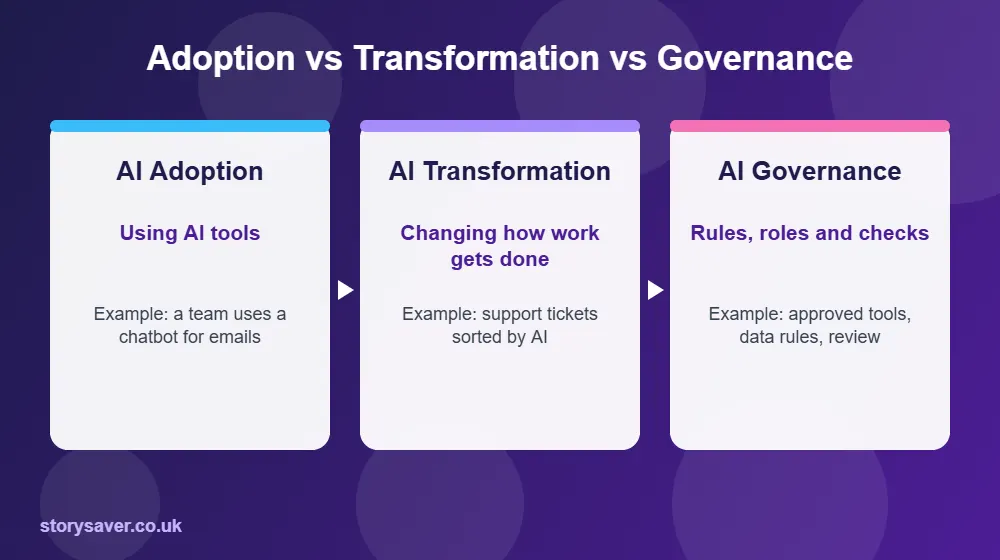
| AI adoption | AI transformation | AI governance | |
|---|---|---|---|
| What it means | Using AI tools | Changing how work is done with AI | The rules and people in charge of AI |
| Simple example | A team uses a chatbot to write emails | AI sorts customer support tickets, and the team changes its process around it | Deciding which tools are allowed, what data they can use, and who checks the results |
| Who usually leads it | Single employees | Managers and team leaders | Leaders, IT, legal, security and data teams |
| What happens if it is missing | Too many tools and hidden risks | Test projects that never grow | Rules that nobody follows |
Think of it like driving. Adoption is buying cars. Transformation is using those cars to run your whole delivery business. Governance is the traffic lights, driving licenses and insurance. Without governance, more cars just means more accidents.
Why AI Projects Get Stuck: 5 Common Gaps
If AI transformation is a problem of governance, the numbers should show it. And they do.
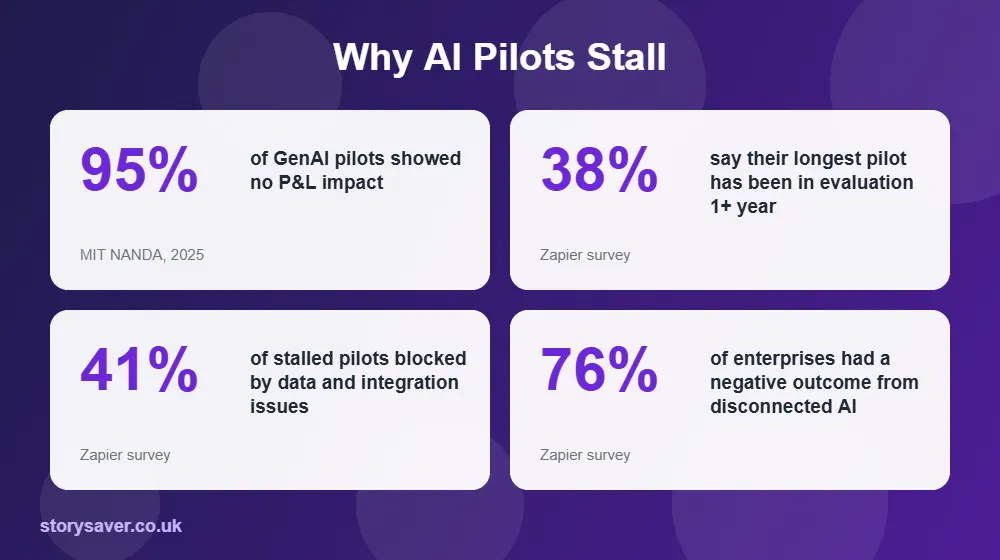
- A 2025 MIT NANDA report called The GenAI Divide found that about 95% of company generative AI pilots (small test projects) showed no clear effect on profit.
- A Zapier survey of 835 business leaders found that 38% said their longest AI test project had been “in evaluation” for more than a year.
- The same survey found that problems with systems, data quality and connecting tools blocked 41% of stuck projects.
- Zapier also reports that 76% of companies had at least one bad result from AI tools that were not connected or managed well.
Sources: Zapier survey on AI governance and Fortune on the MIT GenAI Divide report
So where do these projects go wrong? Usually in one of these five places.
1. Nobody owns the project
The AI project belongs to “the innovation team,” or IT, or whoever was excited about it first. When a big question comes up, like “Should we launch it?” or “Who will pay for it?”, nobody has the power to decide.
2. The test never ends
This is the 38% from the Zapier survey. A test project looks good, but nobody decided what “success” means before it started. So it never passes and it never fails. It just stays in testing.
3. Too many tools and “shadow AI”
Every team picks its own AI tool. Some of these tools are not approved at all. This is called shadow AI: AI tools that people use at work without IT or managers knowing. Costs go up, and company data ends up in places it should not be.
4. Messy data and no data rules
AI is only as good as the data you give it. If nobody is responsible for data quality, or for deciding what data AI can use, you get wrong answers or data leaks. This is the 41% from the survey again.
5. Nobody checks the AI’s work
The AI writes a reply, gives advice or scores a job applicant, and the result goes straight to a real person. No human checks it. No one watches for mistakes.
Is It Really a Governance Problem?
This is a fair question. Saying AI transformation is a problem of governance does not mean nothing else matters. Some experts said the MIT 95% number makes things look too simple. For example, it mostly measured profit over a short time. That is a fair point. Not every “failed” test project was useless.
Skills also matter. So does good data. So does choosing the right job for AI in the first place. But look closer at those other problems:
- Bad data usually means nobody is responsible for the data.
- The wrong AI project usually means nobody made a clear decision.
- Missing skills usually means nobody planned training.
In each case, the root problem is the same: no clear owner and no clear rules. That is why governance is the problem that connects all the others. It is not the only problem, but it decides if the other problems get fixed.
What Goes Wrong Without AI Governance
Two well-known cases show what happens when nobody is checking.
Amazon’s hiring tool. In 2018, Reuters reported that Amazon stopped using an experimental AI hiring tool. The tool gave lower scores to résumés that included the word “women’s,” like “women’s chess club.” It learned from old hiring data, and that data was unfair to women. Nobody had tested the tool for this kind of bias.
Air Canada’s chatbot. In February 2024, a Canadian tribunal (a type of court) ruled against Air Canada. Its website chatbot gave a customer wrong information about a refund. Air Canada said the chatbot was responsible for its own answers. The tribunal said no: the company is responsible.
The lesson is simple. If AI speaks or makes decisions for your company, your company is responsible for the result. Governance helps you catch problems before they happen.
What Good AI Governance Looks Like
Once you accept that AI transformation is a problem of governance, the next question is: what does good governance look like? Good news: you do not need a 60-page rule book. For most companies, one page is enough.
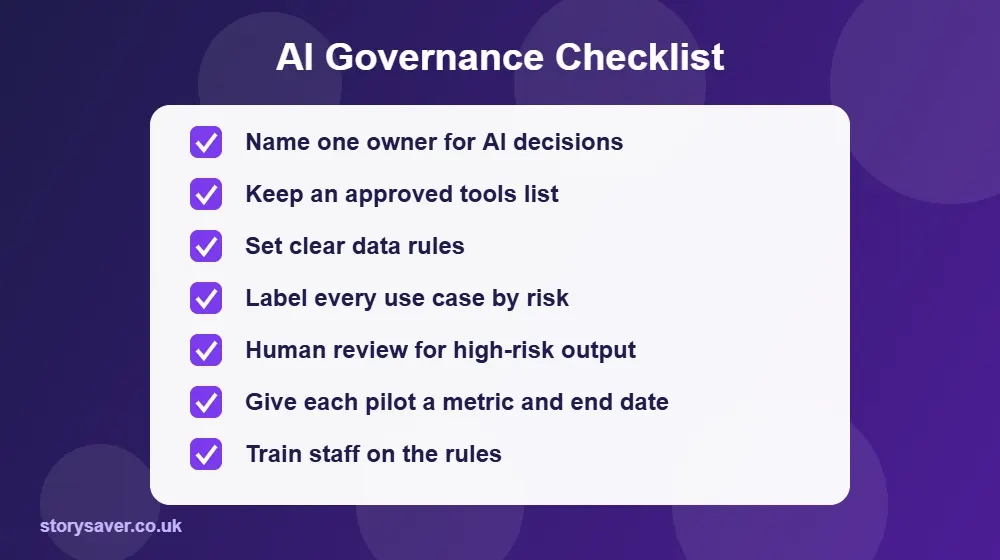
| Area | What good looks like | Quick test |
|---|---|---|
| Owner | One person or a small group makes AI decisions | Can you name them right now? |
| Approved tools | A short list of tools staff can use, and a way to ask for new ones | Do people know where the list is? |
| Data rules | Clear rules on what data can go into which tools (customer data, money data, code) | Would a new intern know what not to paste? |
| Risk levels | Low-risk tasks (like writing emails) move fast. High-risk tasks (like hiring, pricing or health) get extra checks | Is every AI task marked low or high risk? |
| Human check | A person checks AI work before customers see it, for high-risk tasks | Who gives the final OK? |
| Results | Each test project has a goal and an end date | Could you stop a project next month if it fails? |
| Training | Staff know the rules and why they matter | Has anyone been trained yet? |
Quick tip: start with the approved tools list and the data rules. These two steps stop most shadow AI and most data leaks.
AI Governance Frameworks You Can Use
You do not have to build your rules from zero. If AI transformation is a problem of governance, ready-made frameworks (sets of guidelines) are a shortcut. These three are the best known.
| Framework | What it is | Best for |
|---|---|---|
| NIST AI Risk Management Framework (AI RMF 1.0, January 2023) | Free US guidelines to find and manage AI risks. Using them is voluntary | Any company that wants a clear, practical plan |
| ISO/IEC 42001 (December 2023) | An international standard for managing AI. Companies can get certified | Companies that want official proof they use AI responsibly |
| EU AI Act (in force since August 2024, rules start in stages) | A European law that groups AI uses by risk, with stricter rules for high-risk uses | Any company that sells or works in the EU |
Official pages: NIST AI RMF, ISO/IEC 42001 and the EU AI Act overview.
For a small or mid-size company, the NIST framework is the easiest place to start. It is free, it is written in fairly plain language, and you can use only the parts you need.
How to Fix It: A 7-Step AI Governance Plan
If AI transformation is a problem of governance, the fix is a governance plan. Here is a simple one you can start this month.
- Choose an owner. Pick one person, or a small group from leadership, IT and legal. They make the final decisions about AI tools and projects.
- List the AI tools people already use. Ask every team, and include free tools. The list will probably surprise you.
- Write a one-page AI policy. Write down the approved tools, the things AI must not be used for, and the data that must never go into AI tools.
- Sort AI tasks by risk. Writing a blog post is low risk. Checking job applications or giving refund advice is high risk and needs a human check.
- Give every test project a goal and a deadline. “Answer support tickets 20% faster in 90 days” is much better than “let’s see what happens.” If it misses the goal, stop it or change it.
- Train your people. A 30-minute session with real examples works better than a long document nobody reads.
- Review every three months. AI tools change fast. Keep what works, drop what does not, and update your policy.
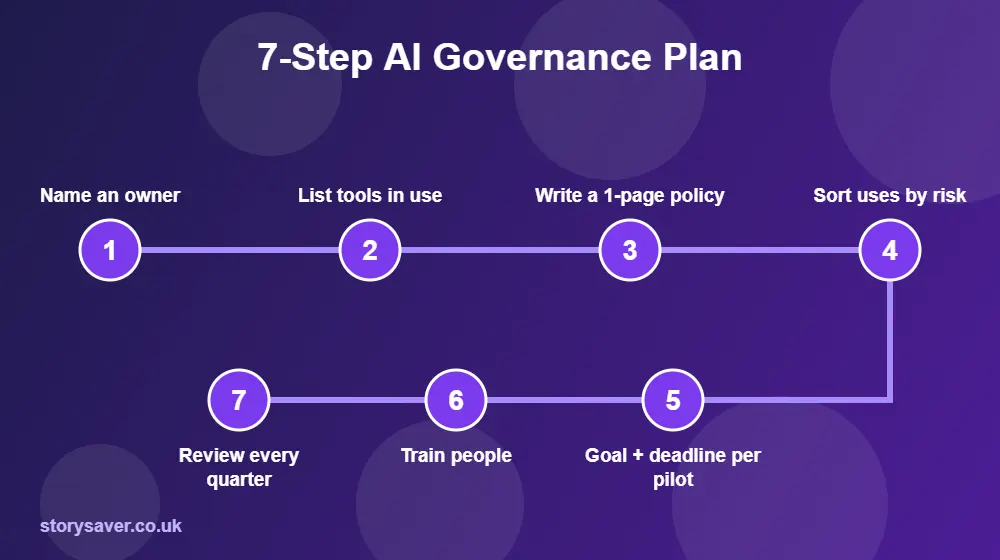
The most common mistake? Companies jump straight to step 5 and skip steps 1 to 3. Then the test project “works,” but nobody can approve it, pay for it or roll it out.
Final Thoughts
AI transformation is a problem of governance because the tools are the easy part. The hard part is deciding who is in charge of AI, what it is allowed to do, and how you will know it is working.
You do not need a big team or an expensive consultant. Choose an owner, write a one-page policy, sort your AI tasks by risk, and give every test project a deadline. Just doing this puts you ahead of most companies whose AI projects are stuck.
Want more simple guides like this? Browse our AI guides and pick your next read.
FAQ
Do we need an AI policy if we only use ChatGPT?
Yes, but it can be short. Even with one chatbot, your team needs to know what is safe to paste into it. A few simple rules about customer data, passwords and private files cover most of the risk.
Does a small business need AI governance?
Yes, just a smaller version. A one-page policy, a list of approved tools and one rule about customer data are enough for most small businesses. It takes an afternoon, not months.
What is the difference between AI governance and AI ethics?
AI ethics is about what is right, like being fair and honest. AI governance is how a company makes sure that actually happens every day: who checks the work, what is allowed, and what to do when something goes wrong.
What is shadow AI?
Shadow AI means AI tools that staff use for work without approval, often free chatbots. It is common. The main risk is that company data ends up in tools nobody has checked.
How long does it take to set up AI governance?
A basic setup (an owner, a policy, a tools list and data rules) can be ready in a few weeks. A full program based on frameworks like NIST AI RMF or ISO/IEC 42001 takes longer, often several months.
Is AI governance the same as compliance?
No. Compliance means following laws, like the EU AI Act. Governance is bigger. It includes your own rules, roles and checks. Good governance also makes compliance much easier.